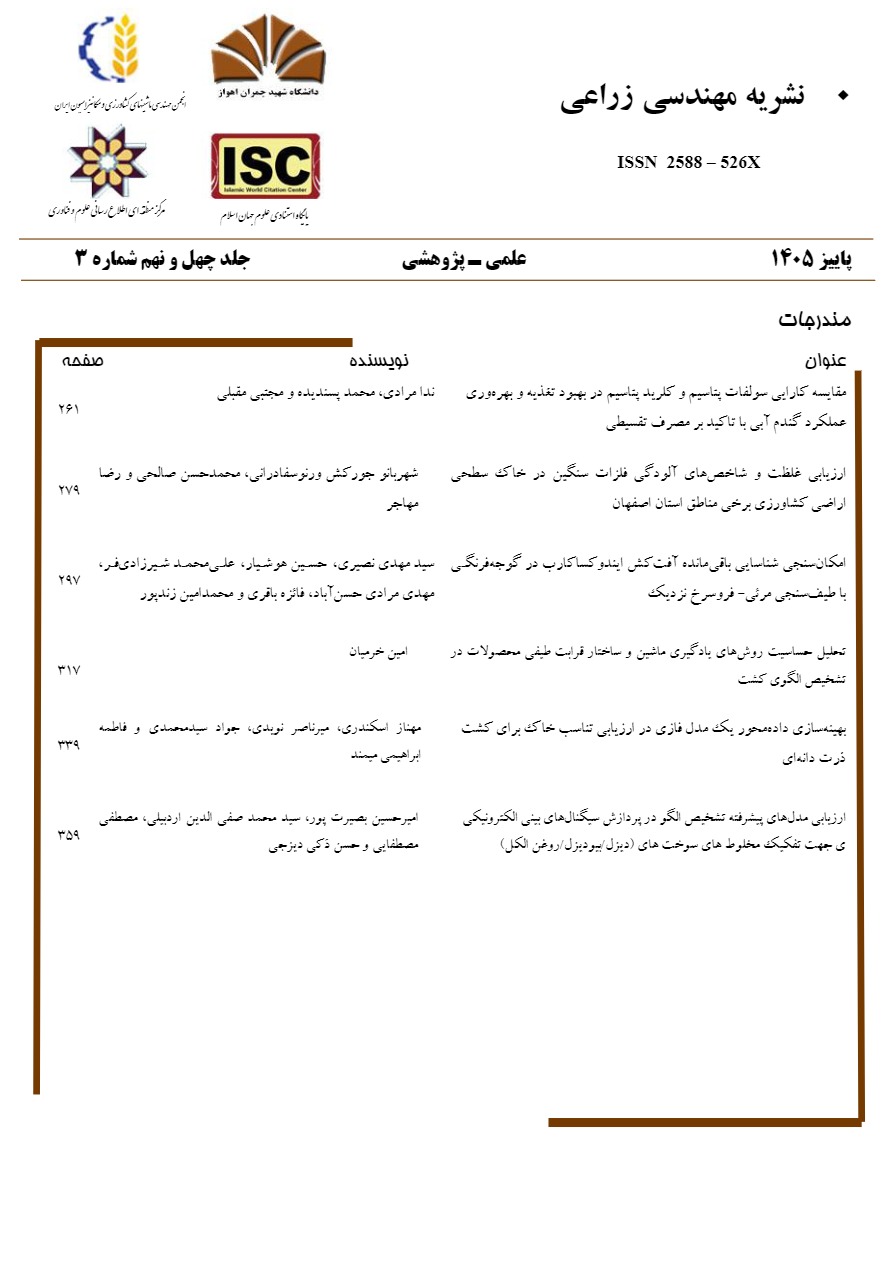
نوع مقاله : کاربردی
نویسندگان
1 دانشیار بخش تحقیقات خاک و آب، مرکز تحقیقات و آموزش کشاورزی و منابع طبیعی استان آذربایجان غربی، سازمان تحقیقات، آموزش و ترویج کشاورزی، ارومیه، ایران
2 استادیار بخش تحقیقات حاصلخیزی خاک و تغذیه گیاه، موسسه تحقیقات خاک و آب کشور، سازمان تحقیقات، آموزش و ترویج کشاورزی، کرج، ایران
کلیدواژهها
عنوان مقاله English
نویسندگان English
Introduction: Wheat (Triticum aestivum L.) is one of the world's most important cereal crops and plays a vital role in global food security. Efficient potassium management is essential for sustaining wheat productivity and improving potassium use efficiency, particularly in calcareous soils where potassium availability is often restricted despite adequate total soil K reserves. Potassium sulfate (SOP) and potassium chloride (MOP) are the two most commonly used potassium fertilizers; however, comparative information on their agronomic performance under irrigated calcareous soil conditions remains limited. Therefore, this study was conducted to evaluate the effects of these two potassium sources on wheat productivity, nutrient uptake, potassium use efficiency, and economic profitability.
Materials and Methods: A field experiment was conducted during the 2023–2024 growing season at the Aibolu experimental farm (Urmia) using a randomized complete block design with three treatments (NP control, SOP at 100 kg ha-1, and MOP at 80 kg ha-1) and five replications. Application rates were adjusted to provide equivalent amounts of K₂O, and potassium was applied in split applications at tillering and stem elongation. At physiological maturity, grain yield, yield components, and leaf nutrient concentrations were determined. Agronomic efficiency of potassium (AEK), partial factor productivity of potassium (PFPK), and partial budget analysis were calculated. Data were subjected to analysis of variance (ANOVA), and treatment means were separated using the LSD test at P ≤ 0.05.
Results and Discussion: Potassium fertilization significantly increased grain yield and improved all measured agronomic traits compared with control. Grain yield increased from 5620 kg ha-1 in the control treatment to 6500 kg ha-1 with potassium sulfate (SOP) and 6230 kg ha-1 with potassium chloride (MOP). Straw yield, biological yield, thousand-kernel weight, spike density, and grains per spike also increased significantly following potassium application. Among the two potassium sources, SOP consistently produced superior agronomic performance, suggesting that the additional sulfur supplied by SOP contributed to improved crop performance. Leaf nutrient analysis demonstrated that potassium fertilization significantly improved leaf potassium concentration and enhanced the accumulation of iron and manganese. The greater micronutrient concentrations recorded in the SOP treatment were likely associated with the additional sulfur supplied by potassium sulfate, which improved nutrient availability and uptake under alkaline calcareous soil conditions. This improved nutritional balance likely contributed to enhanced physiological activity and, consequently, greater grain production.
Potassium use efficiency indices also favored the SOP treatment. Agronomic efficiency of potassium (AEK) reached 17.6 kg grain kg-1 K₂O for SOP, compared with 12.71 kg grain kg-1 K₂O for MOP, indicating a substantially greater yield response per unit of applied potassium. In contrast, partial factor productivity of potassium (PFPK) was nearly identical for the two fertilizer sources, with values of 130.0 and 129.8 kg grain kg-1 K₂O for SOP and MOP, respectively. These findings suggest that although both fertilizers produced comparable grain yield per unit of potassium applied, potassium sulfate produced a greater agronomic response than MOP, reflecting the synergistic contribution of sulfur to nutrient utilization and crop productivity. The economic evaluation corroborated the agronomic results. Potassium sulfate produced the highest net benefit (164,150 × 10³ Rials ha-1) and benefit–cost ratio (1.13), compared with potassium chloride, which resulted in a net benefit of 113,090 × 10³ Rials ha-1 and a benefit–cost ratio of 1.09. Despite its relatively higher purchase cost, the superior yield and agronomic efficiency of SOP resulted in greater economic profitability.
Conclusion: potassium fertilization substantially enhanced wheat productivity, nutrient uptake, fertilizer use efficiency, and economic profitability under irrigated calcareous soil conditions. Although both potassium sources exhibited similar partial factor productivity, potassium sulfate consistently outperformed potassium chloride in grain yield, agronomic efficiency, and economic return. The superior performance of potassium sulfate was likely associated with its combined supply of potassium and sulfur, which improved nutrient balance and crop productivity. Therefore, potassium sulfate appears to be a suitable potassium fertilizer source for irrigated wheat cultivated on calcareous soils in northwestern Iran.
کلیدواژهها English