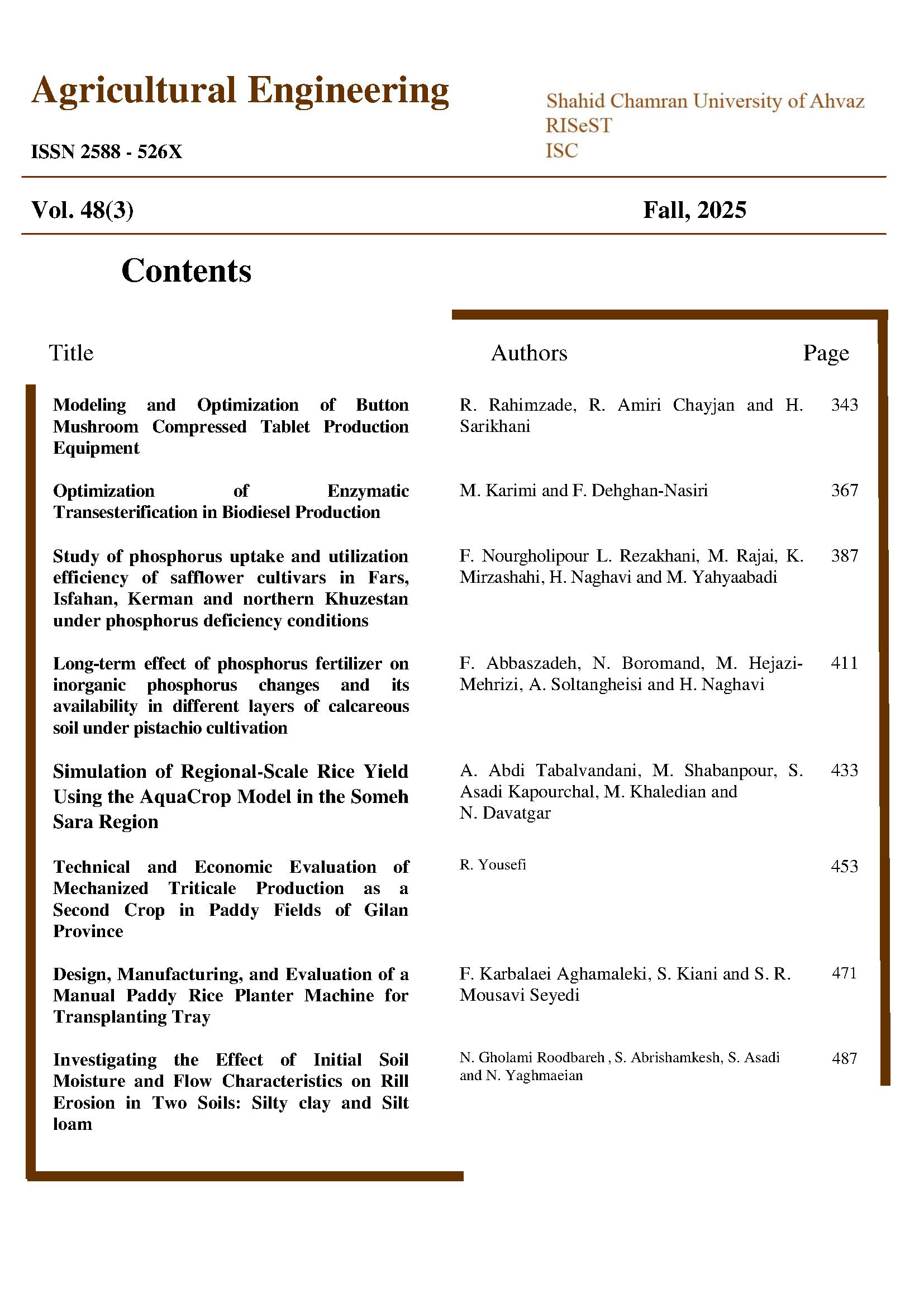
Investigating the Effect of Initial Soil Moisture and Flow Characteristics on Rill Erosion in Two Soils: Silty clay and Silt loam

Document Type : Applicable

Authors

1 MSc Graduate, Department of Soil Science and Engineering, Faculty of Agricultural Sciences, University of Guilan, Iran;

2 Assistant Professor, Department of Soil Science and Engineering, Faculty of Agricultural Sciences, University of Guilan, Iran

3 Associate Professor, Department of Soil Science and Engineering , Faculty of Agricultural Sciences, University of Guilan, Iran

Abstract
Introduction: Rill erosion is considered one of the most significant forms of water erosion. Most existing erosion models have been developed to estimate soil loss and formulate conservation measures. For this reason, spatial and temporal variations of erosion at small scales, such as rill erosion, are often simplified in these models. In addition to soil and flow characteristics, soil resistance to erosion is also a function of dynamic external environmental variables. Among these, soil moisture is an external environmental characteristic that can influence soil resistance to erosion. However, limited information exists regarding the precise role of soil moisture content on resistance to water erosion. Therefore, this research aimed to investigate the effect of initial soil moisture and flow characteristics on rill erosion in two erosion-prone soils containing more than 40% silt but with different textures.

Materials and Methods: Soil samples with silt loam and silty clay textures, having approximately similar silt content, were collected from the 0-10 cm of two rain-fed farmlands exhibiting signs of rill erosion in Shirkuh village, Rudbar, Gilan Province. Soil samples did not have considerable differences in other properties such as organic matter content, calcium carbonate equivalent, aggregate stability, and other characteristics. Measurements of rill detachment capacity (Dc) for both soils were conducted under simulated runoff conditions with four flow discharge rates (0.546, 0.986, 1.125, and 1.895 m³h-1) and two slope levels (0.061 and 0.121 m/m), totaling eight combinations of flow discharge and slope, at five initial moisture levels (5, 10, 15, 20, and 30% by mass) with three replications.

Results and Discussion: The results of the analysis of variance showed that the effects of soil type, moisture level, and the interaction effects between soil type and moisture level on Dc were significant at p <0.01. Results indicated that in both silty clay and silt loam soils, Dc decreased with increasing soil initial moisture content. The soil detachment capacity in silt loam soil, after a decreasing pattern, increased from 0.015 kg m-²s-1 at 20% moisture to 0.086 kg m-²s-1 at 30% moisture, indicating the existence of a moisture threshold for changes in susceptibility to rill erosion. whereas in silty clay soil, the trend of detachment capacity continued to decrease with increasing initial moisture content. Analysis of rill erodibility factor at different moisture levels also revealed a pattern similar to the changes in detachment capacity. In the drier moisture range, initial moisture may lead to increased soil strength, and consequently, soil loss decreases until reaching a moisture content corresponding to the plastic limit. Reduced aggregate breakdown and increased cohesion due to the presence of water films likely explain the greater soil resistance with increasing initial moisture. However, there may be an optimal moisture content beyond which the trend of increasing soil resistance with initial moisture begins to decrease or at least does not show incremental changes. This soil moisture threshold depends on the characteristics of the soil under study, such as the plastic limit, which can also be influenced by texture, especially the clay content of the soil. Therefore, the difference in clay content between the two soils probably caused their different behaviors at various moisture levels. Based on the Pearson correlation test results, the correlation of rill detachment capacity in both soils showed the highest correlation coefficient with the stream power parameter (r = 0.76 to 0.83 in silty clay soil and r = 0.76 to 0.94 in silt loam soil). In silty clay soil, increased moisture generally leads to higher correlation, whereas in silty loam soil, a more complex pattern is observed, with Dc at 10% moisture showing the strongest correlation for most parameters. Initial soil moisture had a significant impact on the relationship between detachment capacity and flow characteristics, though this effect varied between the two soil types.

Conclusion: This finding indicates that rill erodibility is not a constant value and varies depending on the interaction effects between initial soil moisture and the texture of the studied soil. Therefore, although some soil properties such as soil texture are considered unchangeable factors over specific time periods (e.g., days, months, or even years) affecting erosion, the manner in which time-dependent parameters, such as initial soil water content (referred to here as initial soil moisture), and its interaction with soil texture influence erosion remains a subject of interest. Results of correlation between soil detachment capacity and flow hydraulic and hydrodynamic properties suggests that stream power may be a good predictor for soil detachment. Overall, these findings suggest that the influence of dynamic external factors, such as initial moisture level, should be considered for more accurate soil erosion modeling.

Keywords

Subjects

  1. Aksoy, H., Gedikli, A., Yilmaz, M., Eris, E., Unal, N., Yoon, J., Kavvas, M. and Tayfur, G. 2020. Soil erosion model tested on experimental data of a laboratory flume with a pre-existing rill. Journal of Hydrology, 581: 5609-5624. https://doi.org/10.1016/j.jhydrol.2019.124391
  2. Ali, M., Seeger, M., Sterk, G. and Moore, D. 2013. A unit stream power based sediment transport function for overland flow. Catena, 101: 197-204. https://doi.org/10.1016/j.catena.2012.09.006
  3. ASTM D4318-17. 2017. Standard Test Methods for Liquid Limit, Plastic Limit, and Plasticity Index of Soils. ASTM International, West Conshohocken, PA.
  4. Auerswald, K. 1993. Influence of initial moisture and time since tillage on surface structure breakdown and erosion of loessial soil. Catena Supplement, 24: 93-101. https://doi.org/10.1016/0167-1987(94)90031-0
  5. Cao, L.X., Zhang, K.L., Dai, H.L. and Guo, Z.L. 2011. Modeling soil detachment on unpaved road surfaces on the Loess Plateau. Transactions of the American Society of Agricultural Engineers, 54(4): 1377-1384. https://doi.org/10.13031/2013.39039
  6. Chen, X.Y., Huang, Y.H., Zhao, Y., Mo, B. and Mi, H.X. 2015. Comparison of loess and purple rill erosions measured with volume replacement method. Journal of Hydrology, 530: 476-483. https://doi.org/10.1016/j.jhydrol.2015.10.001
  7. Chen, X.Y., Zha, Y., Mi, H.X. and Mo, B. 2016. Estimating rill erosion process from eroded morphology in flume experiments by volume replacement method. Catena, 136: 135-140. https://doi.org/10.1016/j.catena.2015.01.013
  8. Daba, S., Rieger, W. and Strauss, P. 2003. Assessment of gully erosion in Eastern Ethiopia using photogrammetric techniques. Catena, 50: 273-291. https://doi.org/10.1016/S0341-8162(02)00135-2
  9. Fell, R., Hanson, G. J., Herrier, G., Marot, D., and Wahl, T. 2017. Relationship between the erosion properties of soils and other parameters. In S. Bonelli and S. Nicot (Eds.), Erosion in geomechanics applied to dams and levees (pp. 343-381). John Wiley & Sons, Inc. https://doi.org/10.1002/9781118577165.ch5
  10. Flanagan, D.C. and Nearing, M.A. 1995. USDA-Water erosion prediction project: Hillslope profile and watershed model documentation. NSERL Report No. 10. USDA-ARS National Soil Erosion Research Laboratory, West Lafayette, IN.
  11. Gil, E., Kijowska-Strugała, M. and Demczuk, P. 2021. Soil erosion dynamics on a cultivated slope in the Western Polish Carpathians based on over 30 years of plot studies. Catena, 207: 105682. https://doi.org/10.1016/j.catena.2021.105682
  12. Gimenez, R. and Govers, G. 2002. Flow detachment by concentrated flow on smooth and irregular beds. Soil Science Society of America Journal, 66(5): 1475-1483. https://doi.org/10.2136/sssaj2002.1475
  13. Gyssels, G., Poesen, J., Nachtergaele, J. and Govers, G. 2002. The impact of sowing density of small grains on rill and ephemeral gully erosion in concentrated flow zones. Soil and Tillage Research, 64(3): 189-201. https://doi.org/10.1016/S0167-1987(01)00263-X
  14. Hanson, G.J. and Cook, K.R. 2004. Apparatus, test procedures, and analytical methods to measure soil erodibility in situ. Applied Engineering in Agriculture, 20(4): 455-462. https://doi.org/ 10.13031/2013.16492
  15. Hanson, G.J. and Robinson, K.M. 1993. The influence of soil moisture and compaction on spillway erosion. Transactions of the American Society of Agricultural Engineers, 36(5): 1349-1352. https:// doi.org/ 10.13031/2013.28469
  16. Holz, D.J., Williard, K.W., Edwards, P.J. and Schoonover, J.E. 2015. Soil erosion in humid regions: a review. Journal of Contemporary Water Research and Education, 154(1): 48-59. https://doi.org/10.1111/j.1936-704X.2015.03187.x
  17. Knapen, A., Poesen, J., Govers, G., Gyssels, G., and Nachtergaele, 2007. Resistance of soils to concentrated flow erosion: A review, Earth-Science Reviews, 80: 75-109. https://doi.org/10.1016/j.earscirev.2006.08.001
  18. Larionov, G.A., Bushueva, O.G., Gorobets, A.V., Dobrovolskaya, N.G., Kiryukhina, Z.P., Krasnov, S.F., Litvin, L.F., Maksimova, I.A. and Sudnitsyn, I.I. 2018. Experimental study of factors affecting soil erodibility. Eurasian Soil Science, 51(3): 336-344. https://doi.org/10.1134/S1064229318030067
  19. Legates, D.R., Mahmood, R., Levia, D.F., DeLiberty, T.L., Quiring, S.M., Houser, C. and Nelson, F.E. 2011. Soil moisture: A central and unifying theme in physical geography. Progress in Physical Geography, 35(1): 65-86. https://doi.org/10.1177/0309133310386514
  20. Li, Z.W., Zhang, G.H., Geng, R., Wang, H. and Zhang, X. 2015. Land use impacts on soil detachment capacity by overland flow in the Loess Plateau, China. Catena, 124: 9-17. https://doi.org/10.1016/j.CATENA.2014.08.019
  21. Li, M., Liu, Q., Zhang, H., Wells, R., Wang, L. and Geng, J. 2022. Effects of antecedent soil moisture on rill erodibility and critical shear stress. Catena, 216: 106356. https://doi.org/10.1016/j.CATENA.2022.106356
  22. Liu, F., Zhang, G.H., Sun, L. and Wang, H. 2016. Effects of biological soil crusts on soil detachment process by overland flow in the Loess Plateau of China. Earth Surface Processes and Landforms, 41(7): 875-883. https://doi.org/10.1002/esp.387
  23. Luk, S.H., Abrahams, A.D. and Parsons, A.J. 1993. Sediment sources and sediment transport by rill flow and interrill flow on a semi-arid piedmont slope, southern Arizona. Catena, 20: 93-111. https://doi.org/10.1016/0341-8162(93)90031-J
  24. Mohamadpour, S., Ruhani, H., Ghorbani Vaghei, H. and Seyedian, S.M. 2016. Understanding rill erosion rate in dry-wet condition. Quarterly Journal of Environmental Erosion Research, 6: 16-29. (In Persian with English Abstrac)
  25. Moragoda, N., Kumar, M. and Cohen, S. 2022. Representing the role of soil moisture on erosion resistance in sediment models: Challenges and opportunities. Earth-Science Reviews, 229: 104032. https://doi.org/10.1016/j.earscirev.2022.104032
  26. Nachtergaele, J. and Poesen, J. 2002. Spatial and temporal variations in resistance of loess-derived soils to ephemeral gully erosion. European Journal of Soil Science, 53(3): 449-463. https://doi.org/10.1046/j.1365-2389.2002.00443.x
  27. Nearing, M.A., Foster, G.R., Lane, L.J. and Finkner, S.C. 1989. A process-based soil erosion model for USDA-Water erosion prediction project technology. Transactions of the American Society of Agricultural Engineers, 32: 1587-1593. https://doi.org/ 13031/2013.31195
  28. Nearing, M.A., Bradford, J.M. and Parker, S.C. 1991. Soil detachment by shallow flow at low slopes. Soil Science Society of America Journal, 55(2): 339-344. https://doi.org/10.2136/sssaj1991.03615995005500020006x
  29. Nearing, M.A., Norton, L.D., Bulgakov, D.A., Larionov, L.T. and Dontsova, K.M. 1997. Hydraulics and erosion in eroding rills. Water Resources Research, 33: 865-876. https://doi.org/10.1029/97WR00013
  30. Nearing, M.A., Simanton, J.R., Norton, L.D., Bulygin, S.J. and Stone, J. 1999. Soil erosion by surface water flow on a stony, semiarid hillslope. Earth Surface Processes and Landforms, 24(8): 677-686. https://doi.org/10.1002/(SICI)1096-9837(199908)24:8<677::AID-ESP981>3.0.CO;2-1
  31. Parker, D.B., Michel, T.G. and Smith, J.L. 1995. Compaction and water velocity effects on soil erosion in shallow flow. Journal of Irrigation and Drainage Engineering, 121(2): 170-178. https://doi.org/10.1061/(ASCE)0733-9437(1995)121:2(170)
  32. Rauws, G. and Auzet, A.V. 1989. Laboratory experiments on the effects of simulated tractor wheelings on linear soil erosion. Soil and Tillage Research, 13: 75-81. https://doi.org/10.1016/0167-1987(89)90039-1
  33. Shahbazi, K., Marzi, M., Mohammadi, M.H., Asadi, H., Fathi Garlidani, A., Hashemi, Nesb Zavareh, K.S., Toloi, R., Beheshti, M., Avizhgan, A. and Cheraghi, M. 2024. Methods of soil analysis: Sampling, chemical, and physical methods. Soil and Water Research Institute of Iran. ISBN: 978-622-6705-36-3.
  34. Sheridan, G.J.A.C., So, H.B.A., Loch, R.J.B.D. and Walker, C.M.A. 2000. Estimation of erosion model erodibility parameters from media properties. Australian Journal of Soil Research, 38: 265-284. https://doi.org/ 10.1071/SR99041
  35. Shainberg, I., Goldstein, D. and Levy, G.J. 1996. Rill erosion dependence on soil water content, aging, and temperature. Soil Science Society of America Journal, 60(3): 916-922. https://doi.org/10.2136/sssaj1996.03615995006000030034x
  36. Shi, Z.H., Yan, F.L., Li, L., Li, Z.X. and Cai, C.F. 2010. Interrill erosion from disturbed and undisturbed samples in relation to topsoil aggregate stability in red soils from subtropical China. Catena, 81(3): 240-248. https://doi.org/10.1016/j.catena.2010.04.007
  37. Stefano, C.D., Ferro, V., Pampalone, V. and Sanzone, F. 2013. Field investigation of rill and ephemeral gully erosion in the Sparacia experimental area, South Italy. Catena, 101: 226-234. https://doi.org/10.1016/j.catena.2012.10.012
  38. Su, Z.L., Zhang, G.H., Yi, T. and Liu, F. 2014. Soil detachment capacity by overland flow for soils of the Beijing region. Soil Science, 179(9): 446-453. https://doi.org/ 10.1097/SS.0000000000000089
  39. Vaezi, A. and Mohammadi, E. 2022. Temporal variation pattern of runoff generation and rill erosion in different soils and slope gradients. Journal of Water and Soil Science, 25(4): 19-31. (In Persian with English Abstrac) https://doi.org/10.47176/jwss.25.4.12741
  40. Valentin, C., Poesen, J. and Li, Y. 2005. Gully erosion: Impacts, factors and control. Catena, 63: 132-153. https://doi.org/10.1016/j.catena.2005.06.00
  41. Wang, J.G., Li, Z.X., Cai, C.F., Yang, W., Ma, R.M. and Zhang, G.B. 2012. Predicting physical equations of soil detachment by simulated concentrated flow in Ultisols (subtropical China). Earth Surface Processes and Landforms, 37(6): 633-641. https://doi.org/10.1002/esp.3195
  42. Wang, B., Zhang, G.H., Shi, Y.Y., Zhang, X.C., Ren, Z.P. and Zhu, L.J. 2013. Effect of natural restoration time of abandoned farmland on soil detachment by overland flow in the Loess Plateau of China. Earth Surface Processes and Landforms, 38: 1725-1734. https://doi.org/10.1002/esp.3459
  43. Wang, D.D., Wang, Z.L., Shen, N. and Chen, H. 2016. Modeling soil detachment capacity by rill flow using hydraulic parameters. Journal of Hydrology, 535: 473-479. https://doi.org/10.1016/j.jhydrol.2016.02.013
  44. Wei, L., Zhang, B. and Wang, M. 2007. Effects of antecedent soil moisture on runoff and soil erosion in alley cropping systems. Agricultural Water Management, 94: 54-62. https://doi.org/10.1016/j.agwat.2007.08.007
  45. Xiao, H., Liu, G., Liu, P.L., Zheng, F.L., Zhang, J.Q. and Hu, F.N. 2017. Response of soil detachment rate to the hydraulic parameters of concentrated flow on steep loessial slopes on the Loess Plateau of China. Hydrological Processes, 31(14): 2613-2621. https://doi.org/10.3390/w17010028
  46. Yang, C. T. 1972. Unit Stream power and sediment transport. Journal of Hydraulics Division. ASCE, 981805 - 1826.
  47. Zhang, G.H., Liu, B.Y., Liu, G.B., He, X.W. and Nearing, M.A. 2003. Detachment of undisturbed soil by shallow flow. Soil Science Society of America Journal, 67(3): 713-719. https://doi.org/10.2136/sssaj2003.7130
  48. Zhang, H.Y., Li, M., Wells, R.R. and Liu, Q.J. 2019. Effect of soil water content on soil detachment capacity for coarse- and fine-grained soils. Soil Science Society of America Journal, 83(3): 697-7. https://doi.org/10.2136/sssaj2018.05.0208