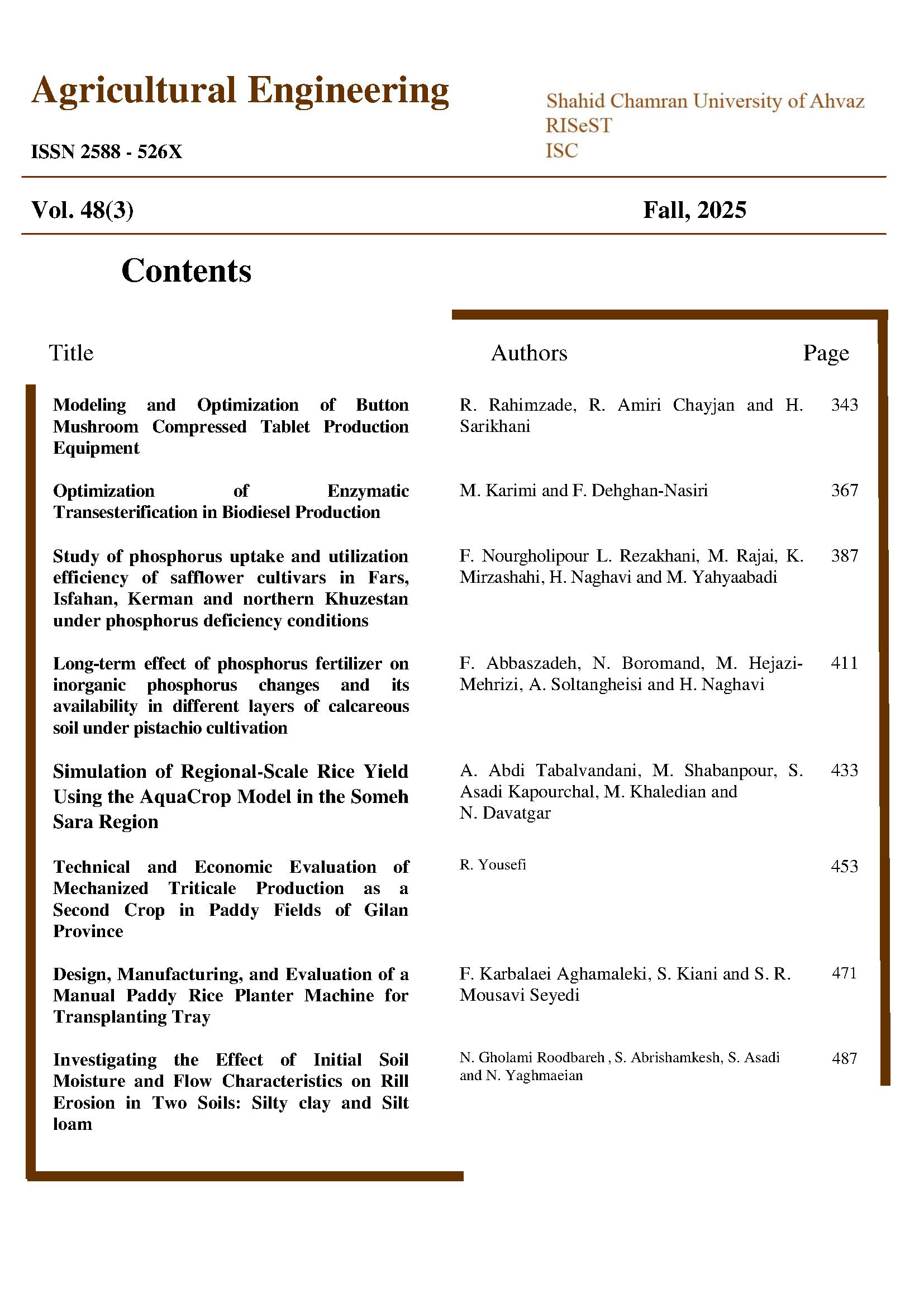
Modeling and optimization of button mushroom compressed tablet production equipment

Document Type : Applicable

Authors

1 PhD Student, Department of Biosystems Engineering, Faculty of Agriculture, Bu-Ali Sina University, Hamedan, Iran

2 Professor, Department of Biosystems Engineering, Faculty of Agriculture, Bu-Ali Sina University, Hamedan, Iran

3 Professor, Department of Horticultural Sciences, Faculty of Agriculture, Bu-Ali Sina University, Hamedan, Iran

Abstract
Introduction: Considering the serious challenges related to the waste of agricultural products and the limitations in the traditional storage and processing methods, the use of new technologies such as drying and tablet production seems necessary. Mushrooms also have antifungal, anti-inflammatory, anti-cancer, antiviral and antibacterial effects. After harvesting, mushrooms have a shorter shelf life than other vegetables due to their high humidity, high respiration rate, lack of cuticle and intense enzymatic activity. They spoil quickly and begin to change color immediately after harvesting. In order to increase their shelf life, edible mushrooms must undergo processing processes, so researchers have investigated various methods for preserving and increasing the shelf life of mushrooms. However, drying is one of the most common methods used for edible mushrooms. Therefore, this research was done with the aim of optimizing the drying and tableting processes for a valuable and perishable product such as edible button mushrooms.

Materials and Methods: Edible button mushrooms were purchased from the local market and after cleaning and washing, they were cut into pieces with a thickness of three millimeters. Then, the samples were placed in the oven for 24 hours to obtain its initial moisture, and finally they were dried by two methods of drying in the shade and drying with a continuous dryer. Then the dried mushrooms were powdered and shaped into smooth round tablets. For this purpose, the tests were defined in the form of a central composite design in Design Expert software version 13. Independent variables (input) to Design Expert software in continuous dryer including temperature (50, 60 and 70 degrees Celsius) and air speed (1.5, 2.5 and 3.5 m/s) and dependent variables for drying included total phenol, antioxidant property and color parameters. Regarding the optimization of the tableting process, independent variables include: pressure (50×105, 60×105, 70×105, 80×105 and 90×105 Pa), stress relaxation time (3, 8, 13, 18 and 22 s) and mold diameter (10, 14, 18, 22 and 26 mm) and the dependent variables included penetration resistance, stress along the diameter and density.

Results and Discussion: According to the findings, the air temperature variable had a greater effect on the response variables than the air velocity variable. According to the results obtained from the optimization, the conditions in which the air temperature was 64.1°C and the air velocity was 2.49 m/s were selected as the optimal conditions with a desirability of 76.3%. The edible button mushroom sample dried in optimal conditions has a total phenol content of 10.7 mg of gallic acid in the weight of the dry sample, antioxidant property of 91.72%, brightness index (L*) 69.73, redness index (a*) was -23.44 and the jaundice index (b*) was 1.80. The shade-dried sample also has a total phenol content of 2.87 mg of gallic acid in the weight of the dry sample, antioxidant property of 91.27%, brightness index (L*) of 72.54, redness index (a*) of 09 -9/ and the yellowness index (b*) was 6.74. According to the total phenol content and antioxidant property in the continuous drying method, this method was more favorable than the shade drying method. Among the factors affecting the mechanical properties of tablets prepared from dried mushroom powder by the continuous method and shade, the die diameter variable was more effective than the other two variables. To optimize the tablet obtained from dried mushroom powder by continuous method, the conditions in which the pressure was equal to 72.74 ×10⁵ Pa, the die diameter was 14 mm, and the stress relaxation time was 8 seconds, with the desirability of 71.8% as a point. Optimum was selected. For shadow-dried mushroom powder tablets, the conditions in which the pressure was equal to 80×105 Pa, the diameter of the mold was 18.70 mm, and the stress relaxation time was 18 seconds were selected as the optimal point with a desirability of 60.1%.

Conclusion: From the comparison of the optimal conditions obtained from the optimization for the two powders dried by the shade and continuous methods, it can be stated that the optimal tablet sample obtained from mushroom powder dried by the continuous method was more desirable than the optimal tablet obtained from mushroom powder dried in the shade.
In general, it can be concluded that drying by continuous method can be a good option to replace drying by traditional method. Because the tablet obtained from mushroom powder dried by the continuous method had a higher density, penetration resistance and stress along the diameter compared to the shadow method.

Keywords

Subjects

  1. Adiba, B. D., Salem, B., Nabil, S., and Abdelhakim, M. 2011. Preliminary characterization of food tablets from date (Phoenix dactylifera L.) and spirulina (Spirulina sp.) powders. Powder Technology, 208(3), 725-730. https://doi.org/10.1016/j.powtec.2011.01.016
  2. Alwazeer, D., and Örs, B. 2019. Reducing atmosphere drying as a novel drying technique for preserving the sensorial and nutritional notes of foods. Journal of Food Science and Technology, 56(8), 3790-3800. https://doi.org/10.1007/s13197-019-03850-2.
  3. Basim, P., Haware, R. V., and Dave, R. H. 2019. Tablet capping predictions of model materials using multivariate approach. International Journal of Pharmaceutics, 569, 118548. https://doi.org/10.1016/j.ijpharm.2019.118548.
  4. Brand-Williams, W., Cuvelier, M.-E., and Berset, C. 1995. Use of a free radical method to evaluate antioxidant activity. Food Science and Technology, 28(1), 25. https://doi.org/10.1016/S0023-6438(95)80008-5.
  5. Canton, H. 2021. Food and agriculture organization of the United Nations—FAO The Europa directory of international organizations 2021 (pp. 297-305): Routledge. https://doi.org/10.4324/9781003179900.
  6. Chen, J., Zhou, Y., Fang, S., Meng, Y., Kang, X., Xu, X., and Zuo, X. 2013. Mathematical modeling of hot air drying kinetics of Momordica charantia slices and its color change. Advance Journal of Food Science and Technology, 5(9), 1214-1219. https://doi.org/10.19026/ajfst.5.3085.
  7. Chin, S., Siew, E., and Soon, W. 2015. Drying Characteristics and quality evaluation of kiwi slices under hot air natural convective drying method. International Food Research Journal, 226. https://doi.org/10.2015/ifrj.22.6.2188.
  8. Dudhat, S. M., Kettler, C. N., and Dave, R. H. 2017. To study capping or lamination tendency of tablets through evaluation of powder rheological properties and tablet mechanical properties of directly compressible blends. Aaps Pharmscitech, 18(4), 1177-1189. https://doi.org/10.1208/s12249-016-0576-1.
  9. Gholami, R., Ahmadi, E., and Ahmadi, S. 2020. Investigating the effect of chitosan, nanopackaging, and modified atmosphere packaging on physical, chemical, and mechanical properties of button mushroom during storage. Food Science and Nutrition, 8(1), 224-236. https://doi.org/10.1002/fsn3.1294.
  10. Horabik, J., Wiącek, J., Parafiniuk, P., Stasiak, M., Bańda, M., and Molenda, M. 2019. Tensile strength of pressure-agglomerated potato starch determined via diametral compression test: Discrete element method simulations and experiments. Biosystems Engineering, 183, 95-109. https://doi.org/10.1016/j.biosystemseng.2019.04.019.
  11. Jafarizadegan, M., Amiri Chayjan, R.,and Karamian, R. 2010. Optimization of a combination dryer (Vacuum-Infrared) operation in production process of edible button mushroom powder. Agricultural Engineering, 43(2), 141-161. https://doi.org/ 10.22055/agen.2020.31903.1528.
  12. Khorsheed, B., Gabbott, I., Reynolds, G. K., Taylor, S. C., Roberts, R. J., and Salman, A. D. 2019. Twin-screw granulation: Understanding the mechanical properties from powder to tablets. Powder Technology, 341, 104-115. https://doi.org/10.1016/j.powtec.2018.05.013.
  13. Ma, Y., Lian, Y., Meng, X., Xu, M., Zhang, T., Zou, H., and Yang, H. 2023. Process optimization of sea buckthorn fruit powder effervescent tablets by random centroid methodology combined with fuzzy mathematical sensory evaluation. Processes, 11(9), 2639. https://doi.org/10.3390/pr11092639.
  14. Naji-Tabasi, S., Emadzadeh, B., Shahidi-Noghabi, M., Abbaspour, M., and Akbari, E. 2021. Physico‐chemical properties of powder and compressed tablets based on barberry fruit pulp. Journal of Food Measurement and Characterization, 15(3), 2469-2480. https://doi.org/10.1007/s11694-021-00834-9.
  15. Ong, M., Yusof, Y., Aziz, M., Chin, N., and Amin, N. M.2014. Characterisation of fast dispersible fruit tablets made from green and ripe mango fruit powders. Journal of Food Engineering, 125, 17-23. https://doi.org/10.1016/j.jfoodeng.2013.10.014.
  16. Pawar, P., Joo, H., Callegari, G., Drazer, G., Cuitino, A. M., and Muzzio, F. J. 2016. The effect of mechanical strain on properties of lubricated tablets compacted at different pressures. Powder Technology, 301, 657-664. https://doi.org/10.1016/j.powtec.2016.05.058.
  17. Rashidi, M., Amiri Chaijan, R., Ershadi, A., and Ghasemi, A. 2020. Modeling and optimization of vacuum-infrared dryer performance in production process of tomato compressed tablet: Chemical properties. Iranian Journal of Biosystems Engineering, 51(3), 571-584. https://doi.org/ 10.22059/ijbse.2020.292861.665245.
  18. Rashidi, M., Chayjan, R. , Ghasemi, A., and Ershadi, A. 2021. Tomato tablet drying enhancement by intervention of infrared-A response surface strategy for experimental design and optimization. Biosystems Engineering, 208, 199-212. https://doi.org/10.1016/j.biosystemseng.2021.06.003.
  19. Rashidi, M., Ershadi, A., and Ghasemi, A. 2021. Investigation of chemical and qualitative properties of compressed tablet production from tomato powder under microwave-hot air condition and process optimization using response surface method. Food Research Journal, 30(4), 83-80. https://doi.org/ 10.22034/fr.2021.31663.1635.
  20. Saifullah, M., Yusof, , Chin, N., and Aziz, M. 2016. Physicochemical and flow properties of fruit powder and their effect on the dissolution of fast dissolving fruit powder tablets. Powder Technology, 301, 396-404. https://doi.org/10.1016/j.powtec.2016.06.035.
  21. Shah, H. G., Dugar, R. P., Li, H., Dave, V. S., and Dave, R. 2019. Influence of punch geometry (head-flat diameter) and tooling type (‘B’or ‘D’) on the physical–mechanical properties of formulation tablets. Drug Development and Industrial Pharmacy, 45(1), 117-123. https://doi.org/10.1080/03639045.2018.1525395.
  22. Singleton, V. L., and Rossi, J. A. 1965. Colorimetry of total phenolics with phosphomolybdic-phosphotungstic acid reagents. American Journal of Enology and Viticulture, 16(3), 144-158. https://doi.org/10.5344/ajev.1965.16.3.144
  23. Sun, C. C. 2005. Quantifying errors in tableting data analysis using the Ryshkewitch equation due to inaccurate true density. Journal of Pharmaceutical Sciences, 94(9), 2061-2068. https://doi.org/10.1002/jps.20421.
  24. Sun, H., Wang, X., Wang, J., Shi, G., and Chen, L. 2020. Influence of the formula on the properties of a fast dispersible fruit tablet made from mango, Chlorella, and cactus powder. Food Science and Nutrition, 8(1), 479-488. https://doi.org/10.1002/fsn3.1330.
  25. Toor, R. K., and Savage, G. P. 2006. Effect of semi-drying on the antioxidant components of tomatoes. Food Chemistry, 94(1), 90-97. https://doi.org/10.1016/j.foodchem.2004.10.054.
  26. Yusof, Y., Mohd Salleh, F., Chin, N., and Talib, R. 2012. The drying and tabletting of pitaya powder. Journal of Food Process Engineering, 35(5), 763-771.https://doi.org/10.1111/j.1745-4530.2010.00625.x.
  27. Zea, L. P., Yusof, Y. A., Aziz, M. G., Ling, C. N., and Amin, N. A. M. 2013. Compressibility and dissolution characteristics of mixed fruit tablets made from guava and pitaya fruit Powder Technology, 247, 112-119. https://doi.org/10.1016/j.powtec.2013.06.032.