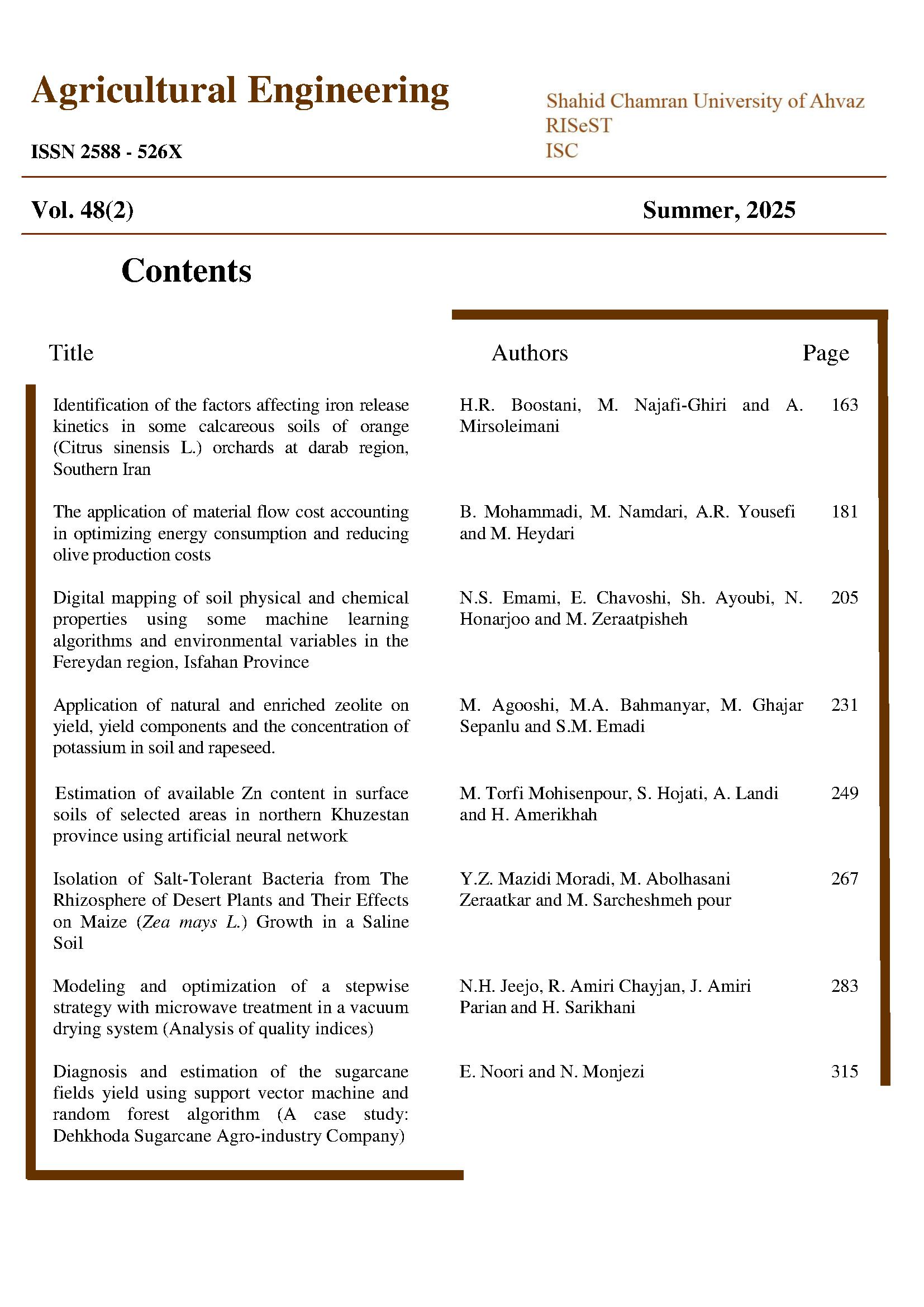
Estimation of Zn available contents in surface soils of selected area in northern Khuzestan Province employing artificial neural network

Document Type : Research Paper

Authors

1 Former M.Sc. student, , Department of Soil Science, Faculty of Agriculture, Shahid Chamran University of Ahvaz, Khuzestan, Iran

2 Professor, Department of Soil Science, Faculty of Agriculture, Shahid Chamran University of Ahvaz, Khuzestan, Iran

3 Professor, Department of Soil Science, Faculty of Agriculture, Shahid Chamran University of Ahvaz, Khuzestan, Iran,

4 Lecturer, Department of Soil Science, Faculty of Agriculture, Shahid Chamran University of Ahvaz, Khuzestan, Iran

Abstract
Introduction: Previous studies indicate that many soils worldwide lack zinc or contain it in a form that is unavailable to plants. In Iran, over 56% of agricultural soils have DTPA-extractable zinc levels below 0.75 mg/kg, while only 31% exceed 1 mg/kg. Therefore, it is crucial to understand the factors influencing zinc concentration and prioritize their significance in the distribution of this essential element in soil. Employing an effective model to comprehend the logical connections within the results is essential. Artificial neural networks, known for their ability to model complex and non-linear relationships between soil variables, have been widely used in numerous studies over the past few decades. Khuzestan province, located in the southwest of Iran, possesses high potential for producing a variety of agricultural and horticultural products due to its water resources and fertile soils. With an output of 17.5 million tons of agricultural and horticultural products, Khuzestan plays a crucial role in ensuring the country's food security. Considering the diverse topography and land uses, this study aims to estimate the available zinc content in the surface soils of a selected area in northern Khuzestan province using artificial neural networks and to identify the key factors controlling its distribution across the study area.
Materials and Methods: Most of the study area is within the catchment area of the Karun River, which forms the backbone of the hydrographic network in Khuzestan province. The eastern sectors are located in the catchment area of the Zohre-Jarhari Rivers. The region has a hot and dry climate, with average rainfall ranging from 240 mm in the center to 590 mm in the eastern parts. Various geological formations, such as Asmari, Gachsaran, and Mishan, are present in this area. The soil moisture regimes include aridic, ustic, and xeric (in the eastern parts), while the temperature regimes are classified as thermic and hyperthermic. The soils in the study area are primarily classified as Aridisol, Inceptisol, and Entisol. Two hundred and three (203) surface (0-10 cm) composite samples were randomly collected from an area of 27,452 square kilometers in northern Khuzestan province. Sampling took place under sunny conditions during winter. The soil samples were air-dried and then passed through a 2 mm sieve. The pH and electrical conductivity of the soil were measured in pastes and saturated extracts, respectively. Soil texture was determined using the pipette method; organic matter was assessed by the wet oxidation method with potassium dichromate; and calcium carbonate equivalent was measured through back titration. To measure the available zinc content in the soils, 10 grams of each soil sample were weighed, and 20 ml of a 0.005 M DTPA solution was added. The suspension was shaken for 2 hours at 120 rpm. Subsequently, the solid and solution phases were separated using Whatman 42 filter paper. Finally, the zinc content of the extracts was measured using a GBS Variant AA atomic absorption device. In the dataset, zinc concentrations of less than 3 mg/kg, between 3 and 6 mg/kg, and greater than 6 mg/kg were categorized as low, medium, and high classes of available zinc content, respectively. A Multilayer Perceptron (MLP) neural network was employed to model available zinc content alongside other soil variables in the SPSS v26 environment, with the optimal structure of the neural network determined through a trial-and-error approach. The normality of the data was assessed using the Kolmogorov-Smirnov test within SPSS v26 software.
Results and Discussion: The results indicated that the average content of available soil zinc in the study area is 2.76 mg/kg. The average calcium carbonate equivalent of the soils is 42.25%, suggesting that the soils can be classified as calcareous. Additionally, with an average pH of 7.65, the soils in the region exhibit alkaline reactions. The average soil organic carbon content is 12.6 g/kg. The findings also suggest that the studied soils primarily belong to the loam family. Among the examined soil properties, the highest coefficient of variation is associated with soil salinity (131.9%), while the lowest is related to soil pH (4.2%). The results of the Kolmogorov-Smirnov test revealed that only the silt content of the soils exhibited a normal distribution pattern; the other variables did not pass the test of normality. When various configurations of multilayer perceptron artificial neural networks were evaluated, it was found that the MLPSO7 model, with a stable arrangement of 3 output classes, 5 hidden layer neurons, and 7 input layers, using the sigmoid function for both input and output activation, performed best in predicting available zinc values in soil samples. The results also indicate that organic carbon, calcium carbonate equivalent, and electrical conductivity were the most influential factors in developing the model. The analysis of the estimation matrix for available zinc classes shows that the MLPSO7 model accurately estimated the class with low concentrations of available Zn more effectively than the other two classes. Furthermore, the soil variables used to model the available zinc contents in the study area were able to accurately estimate these contents (97.4% for the training dataset, 97.1% for the test dataset, and an overall accuracy of 90.8%). In contrast, the class with high concentrations of Zn (>6 mg/kg) produced weaker estimates, which can be attributed to the small number of samples examined in this category.
Conclusion: It can be concluded that the estimates derived from the optimal neural network model demonstrate good flexibility and efficiency in justifying the available Zn contents in the study area. For future large-scale studies, greater attention must be given to the significant roles of organic matter, the abundance of calcareous compounds, and the salt content of the soils in determining available Zn levels.

Keywords

Subjects

  1. Abyat, A., Azhdari, A., Joudaki, M., and Darvishi Khatoni, J. 2017. Study and separation of Quaternary sedimentary environments in Khuzestan plain. Advanced Applied Geology, 7(3), 49-64. https://doi.org/22055/AAG.2017.21931.1702
  2. Alloway, B.J. 2008. Zinc in soils and crop nutrition. Second edition, published by IZA and IFA, Brussels, Belgium and Paris, France.
  3. Ayoubi S., Mehnatkesh A., Jalalian A., Sahrawat K.L., and Gheysari M. 2014. Relationships between grain protein, Zn, Cu, Fe and Mn contents in wheat and soil and topographic attributes. Archives of Agronomy and Soil Science, 60 (5), 625-638. https://doi.org/10.1080/03650340.2013.825899
  4. Banaei, M.H. 1998. Maps of soils moisture and temperature regimes in Iran. Soils and Water Research Institute, Tehran, Iran.
  5. Berger, V.W., and Zhou, Y. 2014. Kolmogorov–Smirnov test: Overview. Wiley Statsref: Statistics reference online. https://doi.org/10.1002/9781118445112.stat06558
  6. Bouasria, A., Ibno Namr, K., Rahimi, A., Ettachfini, E. M., and Rerhou, B. 2022. Evaluation of Landsat 8 image pansharpening in estimating soil organic matter using multiple linear regression and artificial neural networks. Geo-spatial Information Science, 25, 353-364. https://doi.org/10.1080/10095020.2022.2026743
  7. Dhaliwal, S. S., Naresh, R. K., Mandal, A., Singh, R., and Dhaliwal, M. K. 2019. Dynamics and transformations of micronutrients in agricultural soils as influenced by organic matter build-up: A review. Environmental and Sustainability Indicators, 1, 100007. https://doi.org/10.1016/j.indic.2019.100007
  8. Fatehi, Sh., Kafashi, A.K., and Ahmadi, Gh.H. 2017. Probability mapping of deficiency or excess of soil available phosphorus and organic carbon by indicator kriging. Applied Soil Research 5(1), 67-78.
  9. Foth, H., and Ellis, B. 1997. Soil Fertility. United Kingdom, CRC Press, 290p. https://doi.org/10.1201/9780203739341
  10. Gee, G.W., and Bauder, J. W. 1982. Particle-Size Analysis. In Klute, A. (Ed.), pp. 383-411. Methods of Soil Analysis. Part 1: Physical and Mineralogical Properties, 2nd Agron. Monogr.9. ASA and SSSA, Madison, WI, USA.
  11. Geng, W., Li, T., Zhu, X., Dou, L., Liu, Z., Qian, K., Ye, G., Lin, K., Li, B., Ma, X., Hou, Q., Yu, T., and Yang, Z. 2025. Predicting the zinc content in rice from farmland using machine learning models: Insights from universal geochemical parameters. Applied Sciences 15, 1273. https://doi.org/10.3390/app15031273
  12. Hanley, J. A. 1989. Receiver operating characteristic (ROC) methodology: the state of the art. Critical Review in Diagnostic Imaging, 29(3), 307-335. https://doi.org/10.1002/9781118445112.stat05255
  13. Havlin, J. L. 2020. Landscape and Land Capacity. In: Wang, Y. (Ed.), Soil: Fertility and nutrient management. In Landscape and Land Capacity. 2nd Edition, CRC Press, Boca Raton, pp. 251-265. https://doi.org/10.1201/9780429445552
  14. Hazelton, P., and Murphy, B. 2016. Interpreting soil test results: What do all the numbers mean? CSIRO publishing. https://doi.org/10.1071/9781486303977
  15. Hojati, S. 2018. Spatial variability of selected heavy metals in surface soils of northern Khuzestan Province. Project No. 93021034, Iran National Science Foundation, Tehran, Iran, 133 pages.
  16. Hojati, S., Norouzi Masir, M., and Biswas, A. 2022. Modeling distribution of available phosphorous contents in surface soils of northern Khuzestan Province using linear and random forest models. Iranian Journal of Soil and Water Research 53 (6), 1331-1344. http//doi.org/10.22059/ijswr.2022.342792.669262
  17. Keshavarz, P., Malakouti, M.J., Karimian, N., and Fotovat, A. 2006. The effects of salinity on extractability and chemical fractions of Zn in selected calcareous soils of Iran. Journal of Agricultural Science and Technology, 8, 181-190. http//doi.org/1001.1.16807073.2006.8.2.2.2
  18. Kohli, S., Miglani, S., and Rapariya, R. 2014. Basics of artificial neural network. International Journal of Computer Science and Mobile Computing, 3(9), 745-751.
  19. Lin Y.P., Cheng B.Y., Shyu G.S., and Chang T.K. 2010. Combining a finite mixture distribution model with indicator kriging to delineate and map the spatial patterns of soil heavy metal pollution in Chunghua County, central Taiwan. Environmental Pollution, 158: 235–244. https://doi.org/1016/j.envpol.2009.07.015
  20. Lindsay, W.L., and Norvel, W.A. 1979. Development of a DTPA as a soil response investigation of Mn+ 2 complexation in natural and synthetic organics. Soil Science Society of America Journal, 46, 1137-1143. https:// doi.org/ 10. 2136/sssaj1978. 03615995004200030009x
  21. Ljung, L., and Glad, T. 1994. Modeling of dynamic systems. Prentice-Hall, Inc., 361p. https://doi.org/ 1016/0967-0661(95)90022-5
  22. Loeppert, R.H., and Suarez, D.L. 1996. Carbonate and Gypsum. In: Sparks, D.L., Page, A.L., Helmke, P.A., Loeppert, R.H., Soltanpour, P.N., Tabatabai, M.A., Johnston, C.T., and Sumner, M.E. (Eds.), pp. 437-474. Methods of Soil Analysis. Part 3. Chemical Methods, ASA and SSSA, Madison, WI, USA.
  23. Lowe, N.M., Hall, A.G., Broadley, M.R., Foley, J., Boy, E., and Bhutta, Z.A. 2024. Preventing and controlling zinc deficiency across the life course: A call to action. Advances in Nutrition, 15, 100181. https://doi.org/1016/j.advnut.2024.100181
  24. Mahmoudzadeh, H., Matinfar, H.R., and Taghizadeh-Mehrjerdi, R. 2021. Digitization of soil organic carbon with artificial neural network and multivariate linear regression in Kurdistan province. Journal of Soil Management and Sustainable Production 10(4), 77-98. https://doi.org/22069/EJSMS.2021.18090.1958
  25. Masoudnia, Sh., and Soleimani, A. 2013. The role of zinc in health and disease. Feyz Medical Science Journal 16(7), 771-772.
  26. Mir, H., Gholamalizadeh Ahangar, A., and Shabani, A. 2016. Determination of the most important soil parameters affecting the availability of phosphorous in Sistan Plain, using connection weight method in neural networks. Journal of Water and Soil, 29 (6), 1674-1687. https://doi.org/10.22067/jsw.v29i6.39564
  27. Mirzashahi, K. 2017. Periodic study of soil organic carbon in plains of Khuzestan and providing extensions. Land Management 5(1), 1-12. https://doi.org/22092/LMJ.2017.113290
  28. Nelson, D.W., and Sommers, L. 1982. Total carbon, organic carbon, and organic matter. In: Page, A.L., (Ed.), Methods of soil analysis. Part 2: Chemical and microbiological properties, pp. 539-579. American Society of Agronomy and Soil Science Society of America, Madison, WI, USA.
  29. Olden, J.D., Joy, M.K., and Death, R.G. 2004. An accurate comparison of methods for quantifying variable importance in artificial neural networks using simulated data. Ecological Modeling, 178, 389-397. https://doi.org/1016/S0304-3800(04)00156-5
  30. Ravikovitch, S., Margolin, M., and Navrot, J. 1968. Zinc Availability in Calcareous Soils: I. Comparison of Chemical Extraction Methods for Estimation of Plant Availability Zinc. Soil Science, 105, 57-61.
  31. Rhoades, J.D., 1986. Soluble salts. In: Page, A.L., Miller, R.H., and Keeny, D.R. (Eds.), pp. 167–180. Methods of Soil Analysis, Part 2. Chemical and Microbiological Properties, second ed. ASA and SSSA, Madison, WI, USA.
  32. Savari, Z.., Hojati, S., and Taghizadeh Mehrjerdi, R. 2021. Digital mapping of surface soil salinity in Khuzestan Province, using regression kriging. Journal of Water and Soil Science 25(3), 159-175. https://doi.org/47176/jwss.25.3.24654
  33. Sekula, K., Karlowska-Pik, J., and Kmiecik, E. 2023. The use of artificial neural networks in the determination of soil grain composition. Stochastic Environmental Research and Risk Assessment, 37, 3797-3805. https://doi.org/1007/s00477-023-02480-7
  34. Shahbazi, K., and Besharati, H. 2013. Overview of agricultural soil fertility status in Iran. Land Management, 1(1), 1-15. https://doi.org/22092/LMJ.2013.100072
  35. Sharifi, M. 2014. Land use planning studies of Khuzestan province. Urban Planning and Architecture Studies and Research Center, Tehran, Iran, 461p.
  36. Soleimani, R., Chavoshi, E., Shirani, H., and Esfandiar Pour, I. 2020. Comparison of stepwise multilinear regressions, artificial neural network, and genetic algorithm-based neural network for prediction the plant available water of unsaturated soils in a semi-arid region of Iran (case study: Chaharmahal Bakhtiari province). Communications in Soil Science and Plant Analysis 51(17), 2297-2309. https://doi.org/10.1080/2020.1822385
  37. Wang, Y., Chen, F., Zhang, M., Chen, S., Tan, X., Liu, M., and Hu, Z. 2018. The effects of the reverse seasonal flooding on soil texture within the hydro-fluctuation belt in Three Gorges reservoir, China. Journal of Soils and Sediments 18, 109-115. https://doi.org/10.1007/s11368-017-1725-1
  38. Wang, Y., Yu, T., Yang, Z., Bo, H., Lin, Y., Yang, Q., Liu, X., Zhang, Q., Zhuo, X., and Wu, T. 2021. Zinc concentration prediction in rice grain using back-propagation neural network based on soil properties and safe utilization of paddy soil: A large-scale field study in Guangxi, China. Science of the Total Environment 798, 149270. https://doi.org/10.1016/j.scitotenv.2021.149270
  39. Yazdaninejhad, F., Torabi, H., and Davatgar, N. 2014. Mapping of available Fe, Zn, Cu and Mn in soils of southern Tehran lands by geostatistical and GIS techniques. Iranian Journal of Soil and Water Research 44(4), 383-395. https://doi.org/22059/IJSWR.2013.50411
  40. Yin, G., Chen, X., Zhu, H., Chen, Z., Su, C., He, Z., Qiu, J., and Wang, T. 2022. A novel interpolation method to predict soil heavy metals based on a genetic algorithm and neural network model. Science of the Total Environment 825, 153948. https://doi.org/1016/j.scitotenv.2022.153948