Document Type : Applicable
Authors
1
MSc Student, Department of Biosystems Engineering, Faculty of Agriculture, Bu-Ali Sina University, Hamedan, Iran
2
Professor, Department of Biosystems Engineering, Faculty of Agriculture, Bu-Ali Sina University, Hamedan, Iran
3
Associate Professor, Department of Biosystems Engineering, Faculty of Agriculture, Bu-Ali Sina University, Hamedan, Iran
Abstract
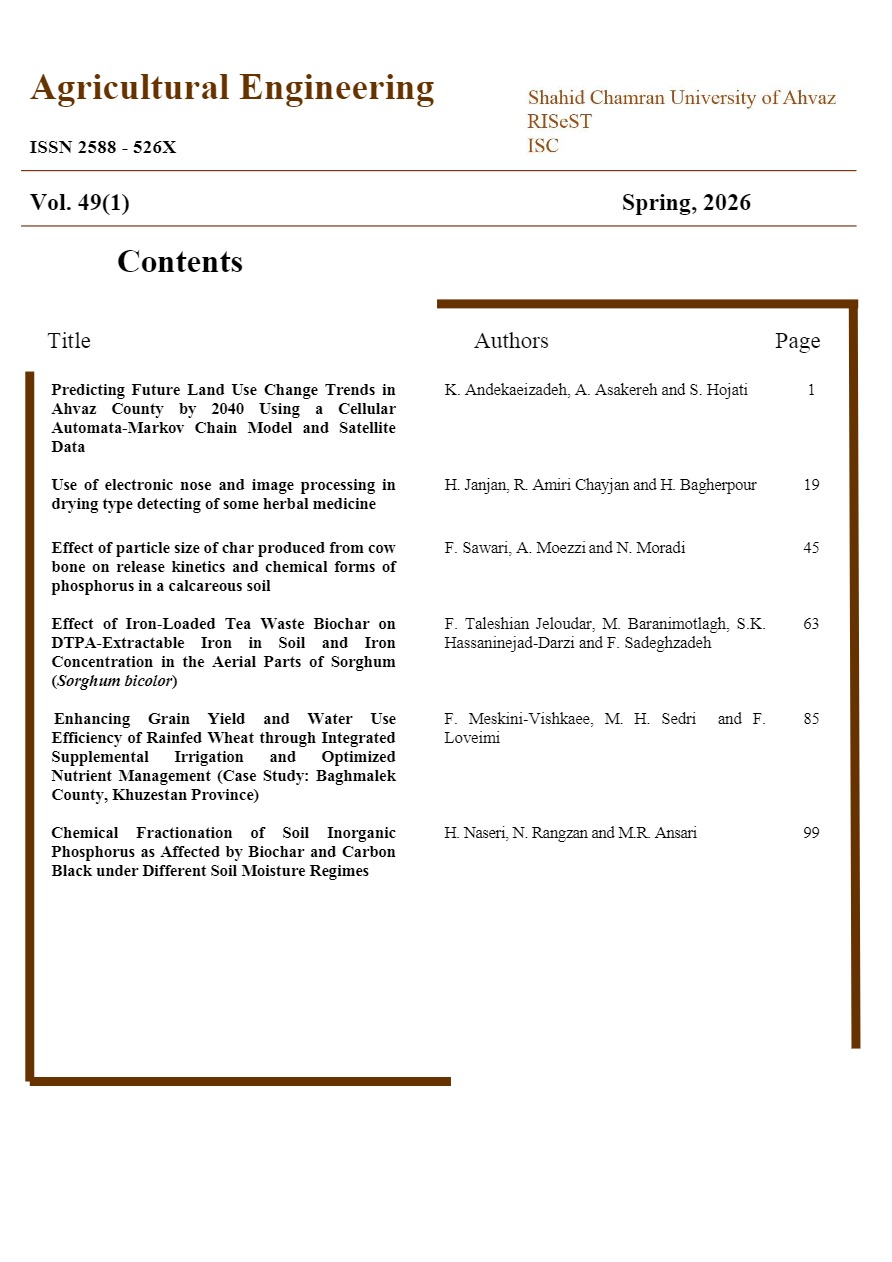
Introduction: Basil, Thymus and Rosemarinus are members of the mint family, which have antibacterial, anti-inflammatory, antifungal, and antioxidant properties. Agricultural products are dried to prevent physical and chemical changes. Drying agricultural products and medicinal plants changes their aroma and color. The aim of this study was to determine the drying type of basil, thyme, and rosemary plants in three drying methods: infrared controlled atmosphere, infrared conventional atmosphere, and shade drying using electronic nose and image processing systems.
Materials and Methods: After purchasing, all samples were stored in a refrigerator (4°C) until the experiments were performed. Three methods of controlled atmosphere infrared, normal atmosphere infrared and shade mathodes were used to dry the samples. Dehumidification time, moisture content, dehumidification rate, and effective diffusion coefficient were evaluated in three drying methods. An electronic nose system consisting of 15 sensors was used to detect odors of fresh and dried samples, and two PCA and SVM methods were used to analyze the data. A machine vision system equipped with a mobile phone camera and light source was used to capture images of fresh and dried plant leaves. The images were recorded in RGB color space format, which was converted to LAB color space using equations.
Results and Discussion: According to the results obtained, the longest moisture removal time for Basil, Thymus and Rosemarinus samples in the shade drying method was 2700, 900, and 5520 minutes, respectively, and the shortest time in the infrared atmosphere control method was 550, 385, and 1300 minutes, respectively.The reason for this is that in the shade drying method, due to high relative humidity and ambient temperature, the rate of moisture removal from the samples is slow, while in the infrared controlled atmosphere dryer, the dehumidification process was accelerated due to the presence of a vacuum in the chamber and the use of infrared lamps due to the depth of penetration into the sample. The results showed that the highest dehumidification rates were for Basil and Rosemarinus samples in the infrared controlled atmosphere dryer and for Thymus samples in the infrared normal atmosphere dryer. The results showed that the first (PC-1) and second (PC-2) principal components were able to cover 53% and 25% of the variance of the input data variable, respectively, and distinguish all three samples well. The MQ2, TGS822, and TGS2610 sensors had the greatest impact on this component. In the discussion of differentiating the type of dryers according to the second main component as well as the loading diagram, the differentiating the type of dryers was done well and the sensors MQ4, MQ2, TGS813, TGS822 and TGS2610 had the highest performance respectively. Based on the results, in the support vector machine method, the training accuracy and classification accuracy for distinguishing samples were 100 and 75 percent, respectively, and based on the type of dryers, they were 41.67 percent and zero, respectively; Therefore, this method was used separately to classify the different drying methods of all three samples, and the training accuracy and classification accuracy were 100% and zero, respectively. The amount of color index G in the dry shade method is closer to fresh Basil and Thymus plants, which could be due to the ambient temperature. The amount of color index B in the normal atmospheric drying method is closer to fresh Basil and rosemarinus, which can be due to the use of infrared lamps, the duration of dehumidification and the pressure inside the chamber. On the other hand, the amount of index B in the dry shade method is closer to the fresh Thymus plant, which is probably due to the ambient temperature. The amount of R index in the normal atmospheric drying method is closer to fresh Rosemarinus plant, which can be due to the use of infrared lamp, the pressure inside the chamber and the time of dehumidification. In the controlled atmosphere dryer, the color index L* is closer to fresh Basil and Thymus plants, which may be due to the use of nitrogen gas, the duration of dehumidification, and infrared lamps. The amount of color index b* in the normal atmospheric drying method is closer to the fresh Basil plant than the dry shade method, which can be due to the use of an infrared lamp, the pressure inside the chamber and the duration of dehumidification. The a* color index in the normal atmosphere drying method is closer to that of fresh Rosemarinus than in the shade drying method.
Conclusion: Compared to the other two methods, the use of infrared atmosphere control dryer has the shortest dehumidification time, the highest coefficient of explanation for Thymus and Rosemarinus samples, and the lowest for Basil samples, and also the highest effective diffusion coefficient. The accuracy of the PCA method for differentiating plants and dryers was 78%, while the training accuracy and classification accuracy of the SVM method for differentiating plants were 100% and 75%, respectively, and 100% and zero for the type of dryers of each plant, respectively. The indices of the two color spaces RGB and Lab depend on the drying conditions in dryers, such as temperature, dehumidification time, air pressure, and heat source. In the RGB color space, the color index R for Rosemarinus plants in the normal atmosphere drying method has less changes than the fresh plant. Also, the color index G for Basil and Thymus plants dried in the shade drying method has less changes than the fresh plant. On the other hand, the color index B for Basil and Rosemarinus plants dried in the normal atmosphere drying method has less changes than the fresh plant. In the Lab color space, the L* color index for Basil and Thymus plants in the controlled atmosphere drying method has less changes than the fresh plant, and the a* and b* color indices for Basil and Rosemarinus plants in the normal atmosphere drying method, respectively, have less changes than the fresh plant.
Keywords
Subjects